Article: Kitchen Faucet Leaking? Here's Why, and How to Fix It
Kitchen Faucet Leaking? Here's Why, and How to Fix It
A kitchen faucet leaking is one of the most common calls a plumber gets, and most of the time it is also one of the easiest fixes. Before you shut off the water to the whole house or start taking the faucet apart, it helps to know where the water is actually coming from. A drip at the spout tip, water weeping from under the handle, and a wet cabinet floor below the sink all point to different problems, and most of them do not mean the faucet needs replacing. This guide walks through the three places a leak usually starts, how to tell which one you have, and when the fix is a short part swap versus a job for a plumber.
In short
- Most kitchen faucet leaks trace to a worn cartridge, not a bad faucet.
- Dry everything, run the faucet, then watch the spout tip, the handle, and under the sink in that order.
- A cartridge swap is a DIY job for most single-handle faucets, and so is tightening a loose supply line.
- A leak that traces into the wall, or a shutoff valve that will not close, is a job for a plumber.
The three places a kitchen faucet actually leaks
| Where you see it | What it usually means | Fix |
|---|---|---|
| Dripping from the spout tip | Worn cartridge or valve seat | Replace the cartridge |
| Water under the handle | Worn cartridge seal | Replace the cartridge |
| Wet cabinet floor below the sink | Loose or worn supply line connection | Tighten or replace the supply line |
How to check each spot
Diagnose it in five steps
- Shut off the waterTurn both shutoff valves under the sink clockwise until they stop. If there are no valves down there, that alone is worth fixing before you do anything else.
- Dry everythingWipe the spout, the base, the handle, and the cabinet floor completely dry with a towel.
- Turn the water back on and run the faucetLet it run for about a minute, then shut it off at the faucet handle, not the valves below.
- Watch for 60 seconds with the water offCheck the spout tip first, then under the handle.
- Open the cabinet and check the connectionsFeel around the supply line nuts and the shutoff valves themselves for dampness, even a small amount.

Why the cartridge is almost always the answer
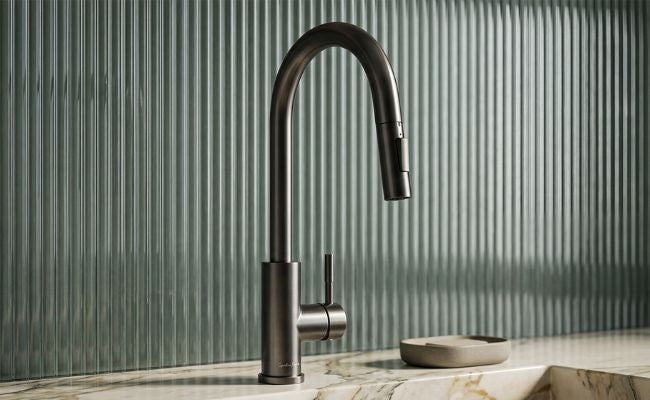
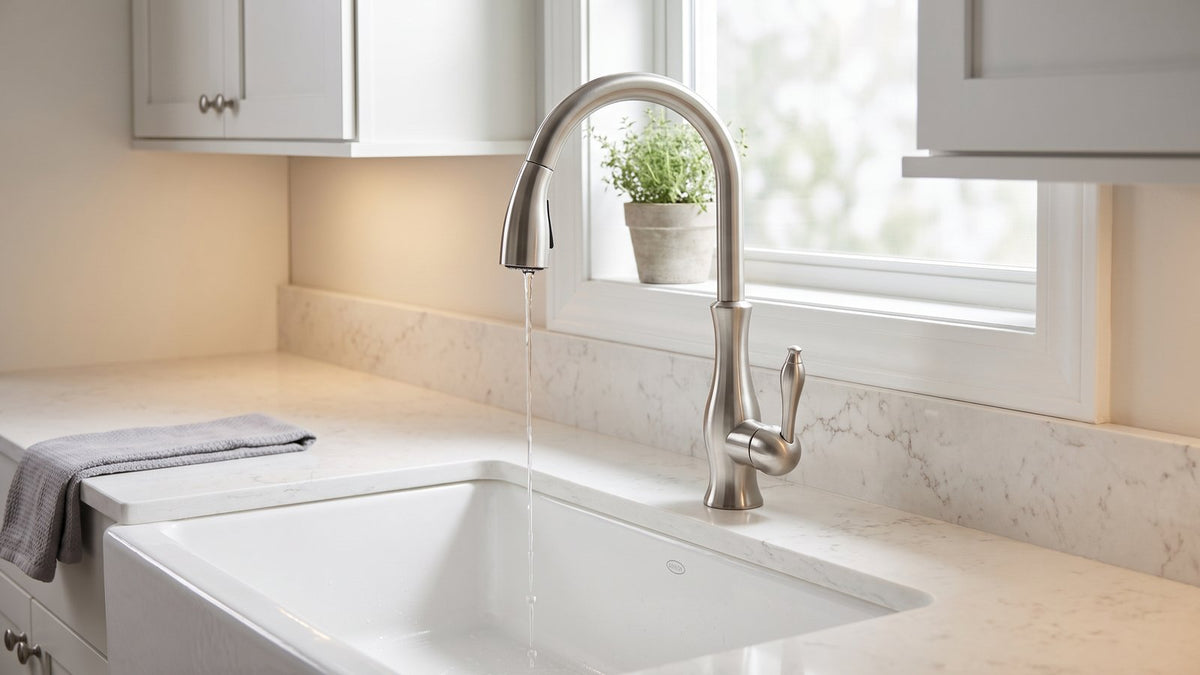
Every Signature Faucets kitchen model, including the Victorian shown above, uses a ceramic disc valve rather than the older rubber washer and stem design. Ceramic discs last far longer, but they are still a wear part, and after enough open close cycles the seal between the two discs stops closing all the way. That shows up as exactly the drip or seep described above. It is not a sign the faucet is failing. It is a normal part reaching the end of its life, the same way brake pads do. The cartridge is covered as a non-electronic part under Signature Faucets' 5-year parts warranty from your purchase date, 2 years if you bought before September 9, 2024. That covers the replacement part itself, not labor or installation, and a claim starts at the warranty claim page with your order number.
Hard water speeds all of this up. Mineral deposits build up inside the cartridge, and that buildup is what turns a slow weep into a steady drip. Softened or filtered water slows the wear down, and soaking the removed cartridge in plain vinegar before reinstalling it often buys another several months before the next swap. None of this stops a cartridge from eventually wearing out. It is a wear part on every faucet, from budget to premium, and replacing it every few years is normal maintenance, not a sign anything went wrong.
How to replace the cartridge yourself
What you will need
- Allen key or hex key set
- Removes the handle set screw
- Channel-lock pliers
- Loosens the retaining nut
- Replacement cartridge
- Matched to your faucet's model, not picked by eye
- Plumber's tape
- For the supply line connections if you disturb them
- Small towel or bucket
- Catches the water still sitting in the lines
The swap, start to finish
- Turn off the water and relieve pressureShut both valves under the sink, then open the faucet fully to drain the lines and confirm the water is really off.
- Remove the handleMost single-handle faucets hide a set screw under a small cap on the handle. Pop the cap with a flathead screwdriver, then back out the screw with an Allen key.
- Remove the retaining nut or clipWith the handle off, a retaining nut or a small clip holds the cartridge in place. Channel-lock pliers usually get a stubborn nut moving.
- Pull the old cartridge straight upIt may stick from mineral buildup. Wiggle it gently rather than prying at an angle, which can crack the housing.
- Match the replacement exactlyBring the old cartridge to the hardware store or match it by the faucet's model number rather than by eye. Two cartridges that look alike can have different valve seats.
- Seat the new cartridge and reassembleLine up the flat side or index tab the same way the old one sat, then reverse the steps: nut or clip, handle, set screw, cap.
- Turn the water back on slowly and testOpen the valves partway first to clear any air in the lines, then run the faucet and recheck all three spots for a full minute.
DIY fix or call a plumber?
What you can usually handle yourself
What works
- Cartridge replacement on a single-handle faucet, usually 15 to 30 minutes with basic tools
- Tightening or replacing a supply line connection under the sink
What to watch
- A leak that traces back into the wall behind the faucet, not just under the sink
- Corroded or seized shutoff valves that will not close or turn
- Any leak on a faucet still within its first year that you would rather have inspected before opening it up
Faucets built for a single hole, like the Discreeto, and two-hole faucets like the Calé, both use the same ceramic disc cartridge design as the Victorian, so the diagnostic steps above apply the same way regardless of which one is on your counter. The hole count changes how the faucet mounts to the sink, not how the cartridge comes apart.
Frequently Asked Questions
Why is my kitchen faucet leaking?
Most of the time it is a worn ceramic disc cartridge, which is a normal wear part rather than a sign the faucet is defective. Less often it is a loose supply line connection under the sink.
Where do kitchen faucet leaks usually start?
The spout tip, under the handle, or the supply line connections below the sink. Running the faucet, then drying and watching each spot for a minute, narrows it down fast.
Is a leaking cartridge covered under warranty?
Yes. Cartridges and other non-electronic parts are covered under Signature Faucets' 5-year parts warranty from your purchase date, 2 years if you bought before September 9, 2024. The warranty covers the replacement part, not labor or installation.
Can I fix a leaking kitchen faucet myself?
In most cases, yes. Replacing a cartridge on a single-handle faucet is a 15 to 30 minute job with basic tools. A leak that traces into the wall, or a shutoff valve that will not close, is a better job for a plumber.
How much does it cost to fix a leaking faucet?
A replacement cartridge typically costs well under the price of a new faucet, and the labor is minimal if you do it yourself. A plumber visit for a straightforward cartridge swap is usually a short, single-trip job.
A leaking kitchen faucet does not usually mean it is time to shop for a new one. Track down which of the three spots is wet, and in most cases the fix is a cartridge, not a whole new faucet. Browse the full kitchen faucet collection if yours turns out to be past its warranty window, or you decide a replacement makes more sense than a repair.