Touch vs Touchless Kitchen Faucet: Which One Wins in a Real Kitchen?
Choosing between a touch vs touchless kitchen faucet comes down to one question: do you want water to respond to a deliberate tap, or to motion near a sensor? A touch faucet turns on when you physically tap the spout or handle, read by a capacitive sensor. A touchless faucet opens the valve when a motion sensor detects a hand, a pan, or anything else moving in front of it. Both spare you from twisting a handle with flour or chicken on your fingers. The practical difference is control. A tap only happens when you mean it. A motion sensor has to guess, and sensors that guess sometimes guess wrong. For most working kitchens, that is the deciding factor, and it is the reason Signature Faucets builds its smart faucets around touch activation.
The short version:
- A touch faucet activates on deliberate physical contact. A touchless faucet activates on detected motion.
- Touch control is more predictable: nothing happens until you tap, so a pet, a passing pan, or a sleeve cannot start the water.
- Touchless is the better fit only when zero contact with the fixture is the whole point.
- Both types keep a standard lever handle for temperature and flow, and both run without any wiring into your home's electrical system.
- Our verdict: touch wins on reliability and everyday control in a busy kitchen.
Touch vs Touchless Kitchen Faucet Pros and Cons
| Factor | Touch faucet | Touchless faucet |
|---|---|---|
| How it activates | A physical tap on the spout or handle | Motion detected in a zone near the sensor |
| Sensing technology | Capacitive sensor that reads body contact | Motion sensor, usually infrared |
| False starts | Rare, because contact is required | Possible from pets, dishes, sleeves, or hand movement near the sink |
| Temperature and flow | Set with the standard lever handle | Set with the standard lever handle |
| Power | Battery box mounted under the sink | Battery pack or plug-in adapter, depending on the model |
| Messy-hands hygiene | Tap with a wrist or forearm, skin never needs to touch the handle | Fully contact-free |
| Best for | Cooks who want the same predictable response every time | Households where no contact at all is the priority |

How Each Technology Works
A touch kitchen faucet is a faucet with a capacitive sensor in the spout and handle that starts or stops water when you tap it with a finger, a knuckle, or the back of your wrist.
A touchless kitchen faucet is a faucet with a motion sensor, typically infrared, that starts water when it detects movement in a defined zone near the spout.
The real difference between touch and touchless kitchen faucet controls is what tells the valve to open. Capacitive sensing works the way your phone screen does: it reads the small electrical charge your body naturally carries, so the faucet responds to contact and only contact. Motion sensing reads movement in space, which means it responds to intended commands and, occasionally, to movement that was never meant as one.
Neither technology replaces the handle. On both types, a standard lever still sets your temperature and flow rate; the sensor simply toggles water on and off at whatever setting you left the handle in. That is worth knowing before you buy: a touchless faucet is not a hands-free temperature control, it is a hands-free on switch.
Everyday Control: The Tap Beats the Wave
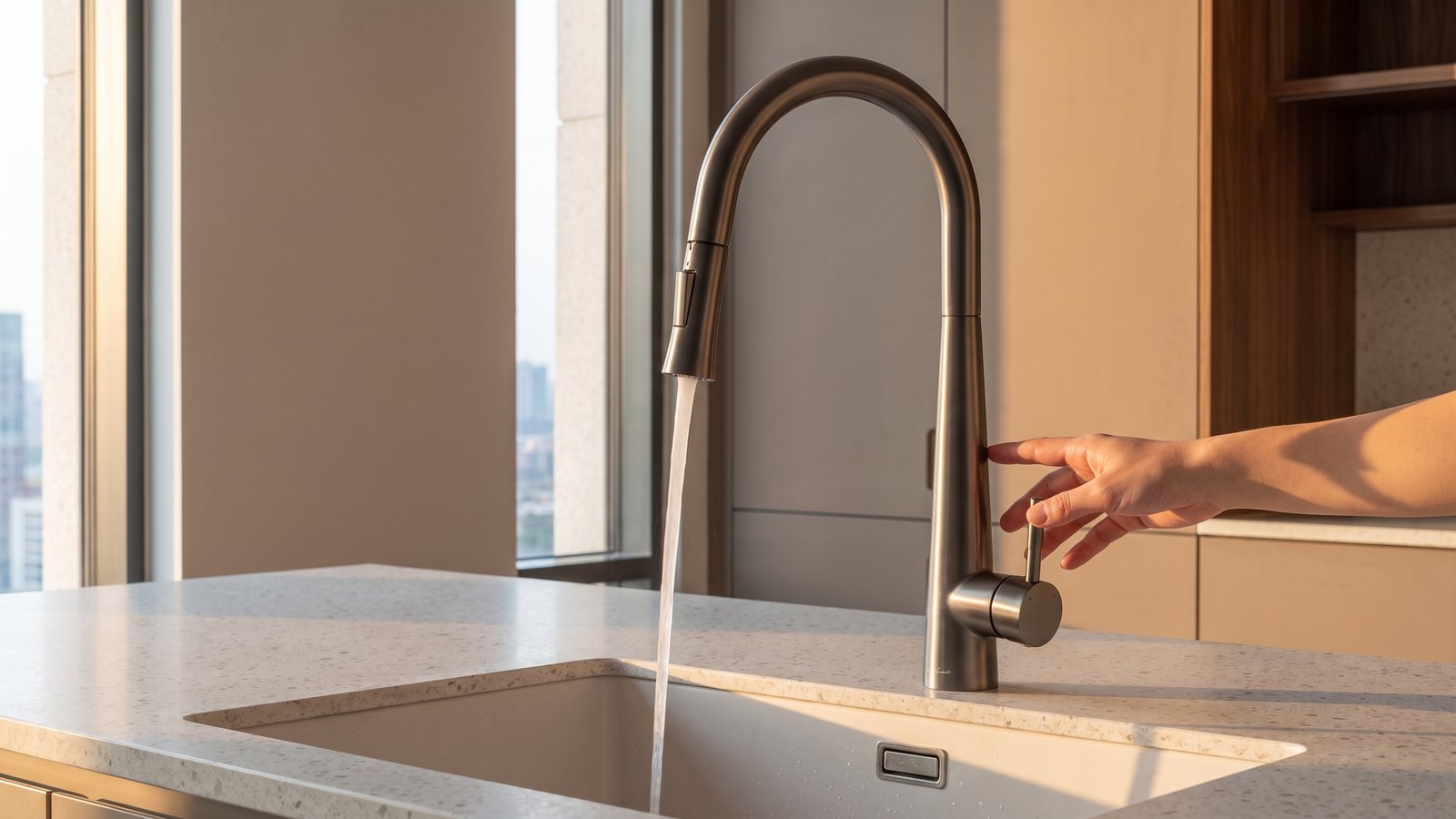
Picture the two most common moments a smart faucet earns its keep: hands covered in flour, or hands full carrying a stock pot. With a touch model, you nudge the spout with your wrist and the water starts. Nudge it again and it stops. There is no sensor zone to find and no wave to repeat because the faucet did not notice the first one.
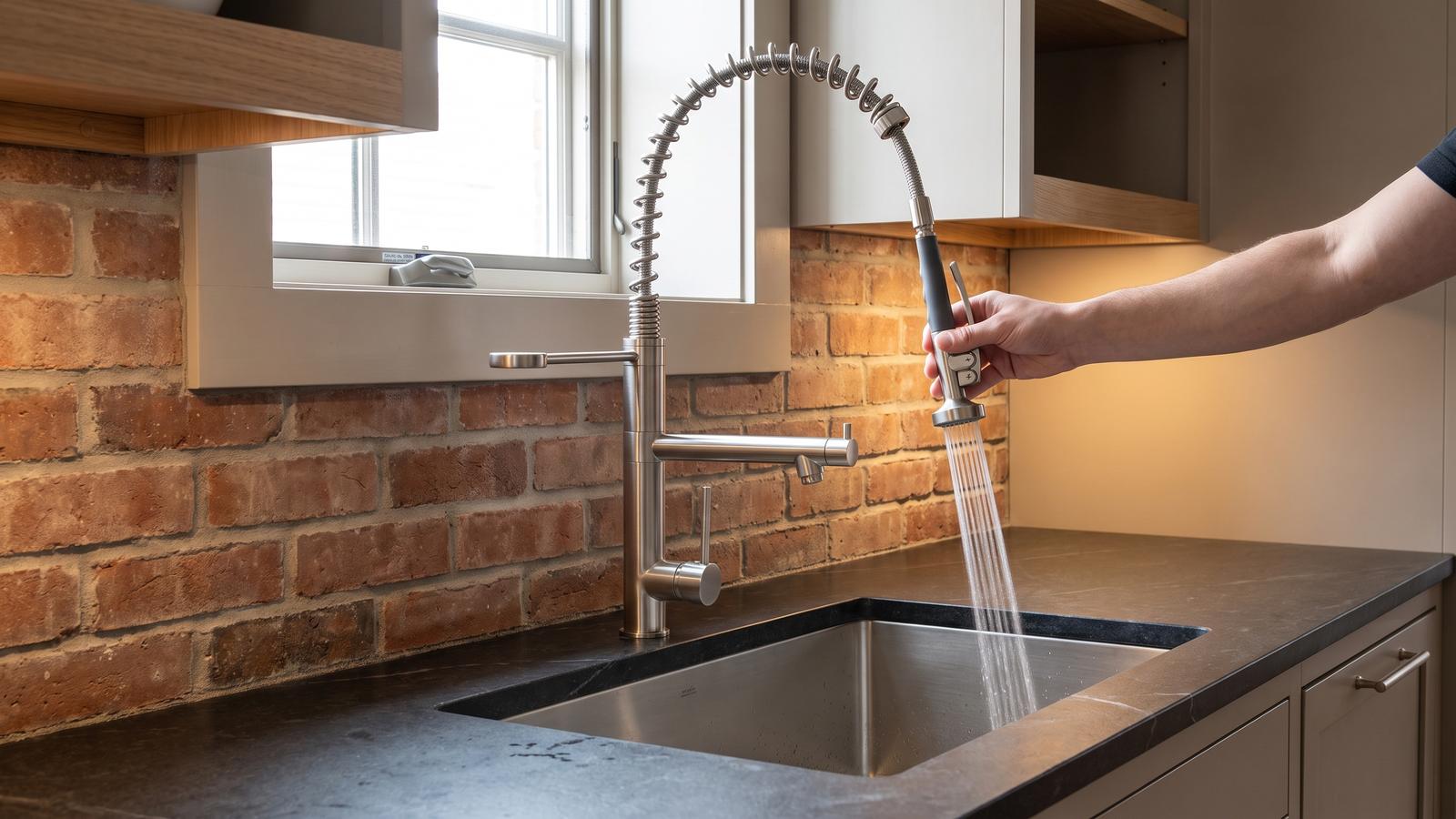
The Imperium touch kitchen faucet with gooseneck pull-down sprayer is a good picture of how this plays out in practice. The capacitive sensor covers the faucet body, the spout swivels a full 360 degrees, and the pull-down spray head switches between an aerated stream and a rinse spray on a 63 inch hose. Every one of those functions responds to a deliberate action: a tap, a turn, a pull, a click. Nothing fires on its own.


With a touchless model, the same two moments usually work well too. The difference shows up at the margins: the sensor has a defined detection zone, and your hand has to enter it cleanly. Wave too high, too low, or too fast and you are waving again. That is not a flaw so much as the nature of motion sensing, but it is a difference you will feel several times a day.
False Triggers: The Case for Requiring Contact
Ask touchless owners about their one recurring annoyance and it is usually phantom activation. A motion sensor cannot tell the difference between a hand asking for water and a cat walking the counter, a colander swinging past the spout, or a sleeve crossing the zone while you wipe the backsplash. Well-designed touchless faucets minimize this with tighter sensor zones and timeouts, but they cannot eliminate it, because reacting to motion is the entire job.
A capacitive touch faucet removes the guesswork. It does not monitor the space around your sink at all. Until something with a body's electrical charge makes contact, the valve stays closed. Motion near the faucet, sunlight shifts, and passing objects are all invisible to it. If you have ever heard a faucet running in an empty kitchen, you understand why deliberate activation is the more relaxing technology to live with.
Batteries and Power: What Lives Under the Sink
Both technologies need power for their sensors and valve. Our touch faucets run on a compact battery box that mounts under the sink with the included kit, so there is no outlet to add and no wiring to run. The Arcus touch faucet ships with the battery box, the touch sensor, and every washer, hose, and fitting for a single-hole installation in one carton.
Touchless faucets draw more standby power because the sensor watches for motion continuously, and models vary between battery packs and plug-in adapters. If your sink cabinet has no outlet, check the spec sheet before you commit; a plug-in touchless model can turn a faucet swap into an electrician visit.
Installation and Cleaning
Installation for a quality touch faucet looks like a standard faucet install plus one extra step: mounting the battery box and connecting the sensor lead. The Arcus, for example, uses a single-hole deck mount, docks its pull-down sprayer with a magnet plus a gravity ball on a 63 inch hose, and toggles spray modes with a rocker switch on the head. Both it and the Imperium are cUPC listed and certified to US drinking-water standards, which is the certification line worth checking on any faucet with electronics inside, touch or touchless.


Cleaning tilts slightly toward touch as well, for an unexpected reason: fingerprints. Because you can operate a touch faucet with a wrist or forearm, the polished surfaces collect fewer smudges than a handle you grab with wet hands. A touchless faucet is contact-free in use, but you will still touch the handle every time you adjust temperature, which in a real kitchen is often.
What About Cost?
Motion sensing generally requires more electronics: the sensor array, a control module, and in many cases a plug-in power supply. Comparable touchless models therefore tend to sit above their touch counterparts in price, and repairs follow the same logic. A capacitive touch system keeps the electronics simpler, which is part of why we chose it. Fewer components watching the world means fewer components that can misread it.
The Verdict: Touch Wins on Control
If you want a faucet that behaves identically every single time, touch is the better technology. Deliberate activation means no phantom starts, capacitive sensing means the faucet ignores everything except an actual tap, and a battery box under the sink means no wiring project. Touchless earns its place in kitchens where avoiding contact entirely is the goal, and that is a legitimate priority for some households. But for the daily rhythm of cooking, rinsing, and filling, predictability is the feature you will notice most, and predictability is what a tap delivers. That conviction is why every model in our touch kitchen faucets collection pairs a capacitive sensor with a high-arc gooseneck spout and a pull-down sprayer: one tap on, one tap off, exactly when you choose.
Frequently Asked Questions
How do touch kitchen faucets work?
A touch kitchen faucet uses a capacitive sensor that reads the natural electrical charge of your body when you tap the spout or handle. The tap toggles water on or off, while the lever handle sets temperature and flow. Our touch models power the sensor with a battery box mounted under the sink, so no wiring is required.
What is the main difference between touch and touchless kitchen faucets?
A touch faucet requires deliberate physical contact to start the water, while a touchless faucet starts when its motion sensor detects movement nearby. Touch gives you more predictable control; touchless removes contact entirely but can respond to motion you did not intend.
Are touch kitchen faucets worth it?
For busy kitchens, yes. A tap with a wrist keeps messy hands off the fixture, the finish collects fewer fingerprints, and the technology adds no wiring because the sensor runs on a battery box under the sink. You give up nothing: the standard handle still works exactly like a conventional faucet.
Can a touchless kitchen faucet turn on by itself?
It can, if something moves through the sensor zone: a pet on the counter, a dish passing the spout, or a sleeve while you wipe the sink. This is a known trait of motion sensing rather than a defect of any one model. Touch faucets do not respond to motion at all, so they cannot start on their own.
What warranty comes with a touch kitchen faucet?
A touch faucet carries a 5-year warranty on its non-electronic parts, including the spray head, cartridge, hose, and supply lines, and a 2-year warranty on the touch sensor and battery box. Batteries are not covered. Every order also includes a 90-day no-hassle return policy and Free US based shipping. Both of our touch models are also cUPC listed and certified lead-free to US drinking-water standards.