
Article: Best Kitchen Faucets: How to Choose the Right One for Your Kitchen


Best Kitchen Faucets: How to Choose the Right One for Your Kitchen
The best kitchen faucets pair a pull-down sprayer with a single hole design and a finish that stands up to daily use. For most US kitchens that combination wins because it reaches every corner of the basin, fills tall pots without splashing, and installs in the sink configuration most counters already have. This kitchen faucet buying guide walks through the seven decisions that actually matter: spout type, activation, spray modes, mounting, finish, docking, and certifications. Every claim in each section comes from real specifications you can check on a spec sheet, not from marketing adjectives. If you are choosing a faucet as part of a renovation, start with spout type and mounting, because everything else follows from those two choices.
The Seven Decisions That Matter
Learning how to choose a kitchen faucet is easier when you take the decisions in order. Here is the sequence this guide follows, from most important to least.
- Spout type. Pull-down gooseneck, pull-down spring, pot filler, or standard spout. This sets how the faucet works every day.
- Activation. Touch sensor or a manual single handle. This decides what happens when your hands are full.
- Spray modes. Stream and spray settings, and the switch that toggles them.
- Mounting. How many holes your sink has and whether the faucet mounts on the deck or the wall.
- Finish. The color and texture of the metal, and how it handles fingerprints and water spots.
- Docking. How the spray head returns to the spout and stays there.
- Certifications. The lead-free and safety standards printed on the spec sheet.

1. Spout Type: The Main Types of Kitchen Faucets
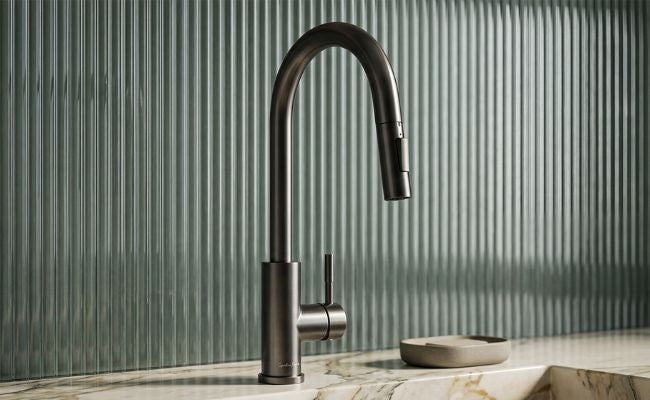
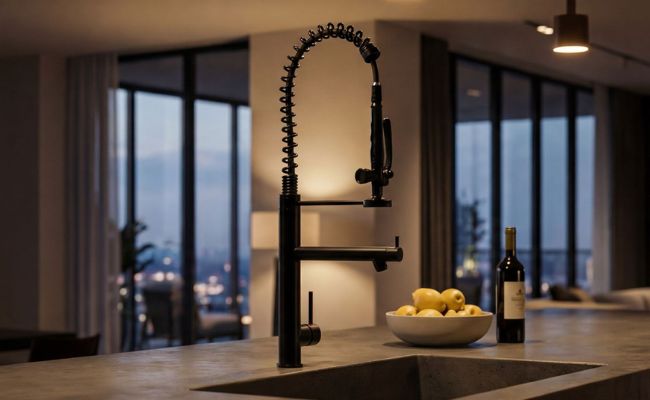
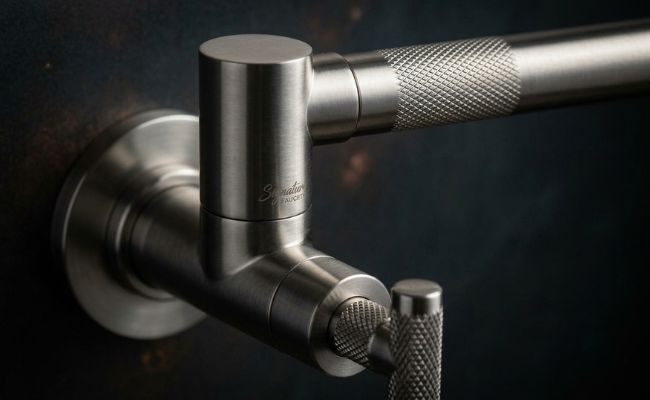
The main types of kitchen faucets are pull-down gooseneck faucets, pull-down spring faucets, pot fillers, and standard spouts with a fixed head. A gooseneck pull-down hides its spray hose inside a tall curved spout, which gives you a clean silhouette and enough clearance to fill stock pots. A spring spout leaves the coil visible, which reads as commercial style and gives the spray head a wide, flexible range of motion over the basin. Pot fillers are a supporting act: a jointed arm that swings out over the stove or sink so you can fill heavy pots where you use them. Some faucets in our collection combine a spring spout with an integrated pot filler arm on the same body, so one fixture does both jobs. A standard spout with a dedicated drinking water outlet is the right pick when a filtered tap matters more than spray reach.
Whichever shape you choose, look for a spout that swivels a full 360 degrees. Every pull-down faucet in our kitchen lineup swivels 360 degrees, which matters more than it sounds in a double basin sink.
2. Activation: Touch Sensor or Single Handle
The best high end kitchen faucets add touch activation to a pull-down design. A capacitive sensor in the spout starts and stops the water when you tap it with a wrist or forearm, so you never grip the handle with flour, dough, or raw chicken on your fingers. The sensor runs on a compact battery box under the sink, and a standard lever still controls temperature and flow, so the faucet works normally even if you never use the touch feature.
If that sounds like your kitchen, look at the Imperium touch kitchen faucet with a gooseneck pull-down sprayer. It pairs the capacitive sensor with a 360 degree swivel spout, a stainless steel spray head, and a 71 inch spray hose that reaches well beyond the basin edge. A manual single handle faucet remains the simpler choice: fewer parts, no batteries, and a lower price of entry into the same spout shapes and finishes.


3. Spray Modes and the Sprayer Control
The best kitchen faucets with sprayer heads give you two distinct modes: an aerated stream for filling and everyday rinsing, and a wider spray for clearing plates and washing produce. Just as important is the switch itself. A rocker switch on the spray head toggles modes with a thumb press and holds its setting. A squeeze trigger, common on commercial style faucets, sprays only while you hold it, which gives you precise bursts and saves water between them.
For a working example of the trigger style, see the Klempner commercial kitchen faucet with a pot filler. It combines a high arc spring spout and squeeze trigger sprayer with a separate pot filler arm that swivels 360 degrees, and it controls hot and cold with two dedicated handles. That two handle layout is a genuine preference question: some cooks want one lever to learn, others want a fixed hot side and cold side they can set without looking.


4. Mounting and Sink Holes
Count the holes in your sink or countertop before you fall in love with a faucet. Every kitchen faucet in this guide installs in a single hole, which is the most common drilling in US sinks and the easiest starting point for a renovation. Deck mount is the standard: the faucet stands on the sink ledge or counter. Wall mount is the exception, used mainly for pot fillers installed over the range, where the arm folds flat against the wall when you are not filling anything.
Two measurements save the most regret. First, check the clearance between the faucet hole and the wall or window sill behind it, because a tall gooseneck needs room to swivel. Second, check the cabinet under the sink, since touch models need space for the battery box and every faucet needs slack for its supply lines.
5. Finish: What Lives With You Every Day
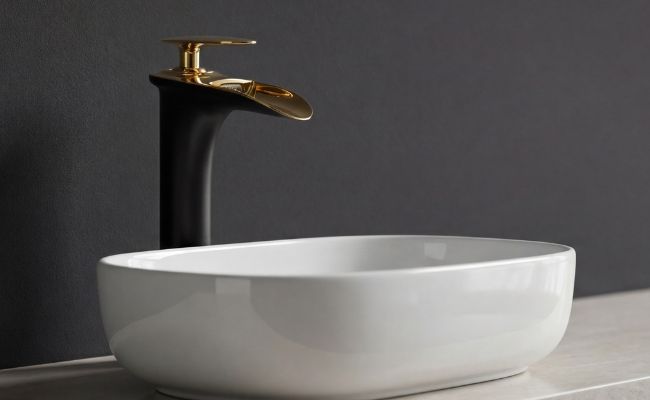
Finish is the decision guests notice and the one you live with at close range. Across our kitchen collection you can choose brushed nickel, matte black, brushed gold, chrome, gunmetal gray, and gold, plus two tone pairings such as matte black with brushed gold. Brushed finishes mask water spots and fingerprints between cleanings, which makes them the practical default for a busy sink. Polished chrome shows marks sooner but wipes back to a shine in seconds. Matte black turns the faucet into a graphic accent against light counters, and a two tone body with a contrasting handle does the same in kitchens that already mix metals.
Finish also decides how traditional or modern the same silhouette feels. A traditional gooseneck design like the Victorian reads classic in gold and quietly contemporary in matte black, while keeping the same pull-down sprayer, rocker switch, and 360 degree swivel underneath. Pick the finish that matches your cabinet hardware first and your appliances second, and the kitchen will read as planned rather than assembled.


6. Docking: How the Spray Head Comes Home
A pull-down faucet is only as good as the way its spray head returns. Three docking systems appear across our collection. A gravity ball weight on the hose pulls the head back into the spout as soon as you let go. A coil spring on a commercial style spout guides the head back with the spring itself. A magnetic dock adds a magnet at the spout tip that snaps the head into perfect alignment and holds it there, so the faucet never sits with a drooping head. Gravity ball systems are simple and proven. Magnetic docking is the upgrade worth asking about if you have seen an older faucet with a sagging sprayer.
7. Materials and Certifications
The spec sheet tells you what the faucet is actually made of. Look for a stainless steel or solid brass body, a stainless steel spray head, and hoses long enough for your sink depth. Spray hoses across our pull-down models run from 63 to 71 inches, which is what lets the head reach a bucket on the floor beside the cabinet. Then check the certifications line. Our touch models are cUPC listed, tested to NSF/ANSI 61 and NSF/ANSI 372, and compliant with California AB1953, the strictest lead-free standard in the country. Those marks mean the faucet was tested for drinking water safety, not just assembled to look the part. A certification line like that, together with a multi-year warranty, is the clearest signal that a faucet is built for a decade rather than a lease term.
Frequently Asked Questions
What type of kitchen faucet is best for most homes?
A single hole pull-down faucet with two spray modes is the best fit for most homes. It covers deep and shallow basins alike, installs in the most common US sink drilling, and keeps the counter around the faucet clean.
Are touch kitchen faucets worth it?
Touch faucets are worth it if your hands are often full or messy while you cook. A capacitive sensor starts the water with a tap of the wrist, and a normal lever still sets temperature and flow, so you lose nothing if you skip the sensor some days.
Which kitchen faucet finish is the most practical?
Brushed finishes such as brushed nickel and gunmetal gray are the most practical because they mask water spots and fingerprints between cleanings. Polished chrome shows marks sooner but wipes back to a shine quickly.
How do I know a new faucet will fit my sink?
Count the holes in your sink or counter and measure the clearance behind and below the faucet location before you buy. Every kitchen faucet in this guide installs in a single hole, the most common US configuration.
What happens if the faucet does not work out?
Every Signature Faucets order includes Free US based shipping, a 90-day return window, and a 5-year warranty on the faucet itself. You can install a faucet, live with it through real cooking, and still be covered.
Shop the Kitchen Faucet Collection
The three faucets discussed in this guide cover the three main directions a kitchen can take. The Imperium brings touch activation to a modern gooseneck. The Klempner brings a commercial spring spout with a built-in pot filler. The Victorian brings a traditional silhouette in four finishes. To compare them side by side with every other style we make, browse the full kitchen faucets collection and filter by spout type, activation, and finish until the shortlist is yours.