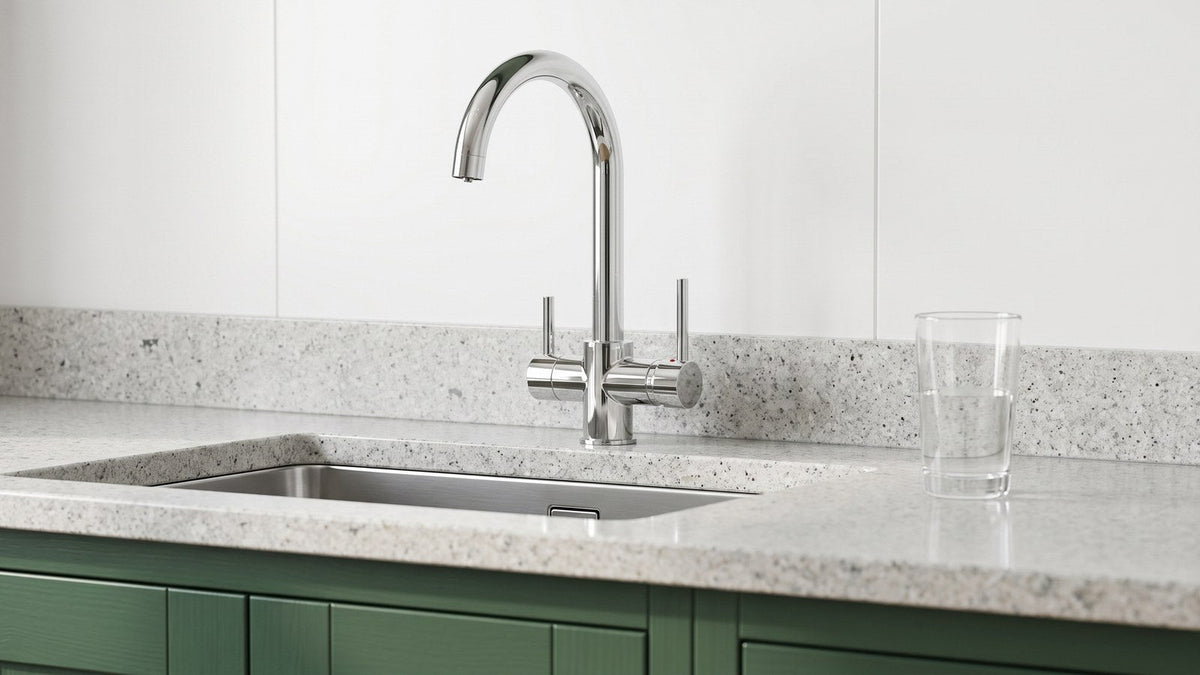
3 Way Kitchen Faucet for RO System: Three Ways to Get Filtered Water at the Sink
A 3 way kitchen faucet for RO system use is one fixture with three separate waterways inside it: hot, cold, and a third line that carries filtered water up from a system installed under the sink. The faucet does not filter anything itself. The filter does that work. The faucet's job is to give filtered water its own path and its own handle so it never shares a passage with the hot and cold supply. Your two alternatives are a small dedicated filter tap drilled into the counter beside your main faucet, or leaving your current faucet alone and running the filter to a tap of its own. This guide compares all three on the things that actually decide it: counter holes, whether the water mixes, filter changes, and what happens to the faucet you already own.
The three options at a glance
The short version:
- One fixture, one hole, two handles, no second tap on the counter: the three way faucet.
- Two fixtures, two holes, and total freedom to keep the main faucet you love: the separate filter tap.
- No new fixture at all, but filtered water shares the spout with everything else: an under sink filter tied into your existing faucet.
| Three way faucet | Separate filter tap | Under sink filter on your current faucet | |
|---|---|---|---|
| Holes needed in the counter | 1 | 2 (main faucet plus the tap) | 0 new holes |
| Filtered water kept separate | Yes, its own internal waterway and handle | Yes, its own fixture entirely | No, it shares the spout and aerator |
| Keeps your existing faucet | No, it replaces it | Yes | Yes |
| Fixtures to clean around the sink | One | Two | One |
| Filter cartridge changes | Same as any under sink system | Same as any under sink system | Same as any under sink system |
| Best when | You are replacing the faucet anyway and want one clean fixture | Your main faucet is new, expensive, or you simply like it | You want filtered water with zero visible change |
What a three way faucet actually is
A three way faucet is a kitchen faucet with a third, isolated waterway for filtered water, operated by its own handle. Some people call it a 3 in one kitchen faucet, a dual spout kitchen faucet, or simply a kitchen faucet with drinking water dispenser built in. They all describe the same idea: one fixture on the counter, but the drinking water route inside it never touches the mixed hot and cold route.
That last part is the whole point. On a standard faucet, water passes through the mixing cartridge, up the spout, and out through an aerator that has been sitting wet since the last time you rinsed a pan. A three way faucet gives filtered water a clean path of its own, from the filter under the sink straight out through a dedicated opening.
The André three way drinking tap is a working example of the type. It has two lever handles, one for the mixed hot and cold supply and one for the filtered line, and it installs through a single hole. The body is solid brass with a ceramic disc valve, the spout swivels 360 degrees, and it runs at 1.8 GPM at 60 PSI, the rate California allows for kitchen faucets. Spout reach is 8.66 inches and spout height is 9.65 inches, with an overall height of 13.39 inches. It ships with hot and cold supply lines, a separate filtered water supply hose, a quick connect elbow fitting, and mounting hardware. It is lead free, and it comes in brushed nickel, chrome, and matte black.
One honest caveat before you go further: a three way faucet does not include a filter, and it does not clean water. Whatever comes out of the drinking side is exactly what your under sink system produces. Choosing this fixture is a plumbing and layout decision, not a water quality one.


Option 1: the three way faucet
Pros
- One hole, one fixture. Nothing extra appears on the counter, which matters on a narrow sink ledge or a slab you would rather not drill twice.
- Filtered water stays on its own waterway from the filter to the outlet.
- One thing to wipe down, one finish to match, one silhouette in the room.
Cons
- It replaces your current faucet. If that faucet is six months old, this is the expensive option by definition.
- Three way models tend to be simpler at the spout. The André, for example, delivers a plain aerated stream and does not pull down or switch to a spray. If you rinse a lot of produce or wash big pans, that is a real daily trade.
- You still have to buy, install, and maintain the filter separately.
Verdict: the strongest choice when you are already replacing the faucet and you want filtered water without a second fixture crowding the sink.
Option 2: a separate filter tap beside your main faucet
This is the small chrome or matte black tap you have seen next to a main faucet in kitchen photos, usually in a sink's fourth hole or a fresh hole drilled in the counter. It is fed by the same kind of under sink system a three way faucet uses.
Pros
- Your main faucet is untouched. Keep the pull-down sprayer, the touch sensor, the finish, all of it.
- Complete separation, since the filtered water never enters the main fixture at all.
- If the filter system is ever removed, the main faucet carries on as normal.
Cons
- You need a spare hole, or you need to drill one. Drilling granite or quartz is a job for a fabricator, not a Saturday.
- Two fixtures means two finishes to match and two bases to clean around.
- Small taps are easy to knock with a stockpot handle, and they take up ledge space you may not have.
Verdict: the right call when the faucet over your sink is new, expensive, or simply one you are not willing to give up. If you are in that position, browse our kitchen faucet collection for the finish you will need to match rather than replacing anything.
Option 3: an under sink filter plumbed into the faucet you already have
Here the filter is spliced into the cold line feeding your existing faucet. No new fixture, no new hole, nothing visible changes.
Pros
- Cheapest path by a wide margin, and the only one that requires no change above the counter.
- Every cold tap draw is filtered, including the water you use for coffee, pasta, and ice.
Cons
- Filtered water shares the spout, the aerator, and the mixing cartridge with untreated hot water. That is the exact separation a three way faucet exists to provide.
- You run every gallon through the cartridge, including the ones you use to rinse plates, so replacements come around faster.
- Reverse osmosis systems in particular produce water slowly into a small tank, which does not suit a faucet you also use for filling pots.
Verdict: a sensible starting point if you are not renovating and just want better tasting water this month. It is the option most people outgrow rather than the one they keep.
The four questions that actually decide it
- How many holes does your counter have, and can you add one? A stainless sink can be drilled. A quartz or granite slab usually cannot, at least not without a fabricator and a real invoice. Count your holes before you fall for a layout you cannot install.
- Does filtered water need to stay separate? If the answer is yes, options 1 and 2 are your list. Option 3 mixes by design.
- How often will you change the cartridge? Every under sink filter has a replacement schedule set by the system, not by the faucet. A cartridge left in past its rated life is doing less than you think it is. Whichever route you pick, put the date in your calendar the day you install it.
- Do you actually like the faucet you have? This is the question that settles it for most people. If you love your current faucet, a three way model is the wrong answer no matter how neat it looks, because it replaces the thing you like.
Fittings, and the check to make before you order
Three way faucets connect to the filter with a small dedicated hose and fitting, which the faucet supplies. The André, for example, includes the filtered water supply hose and a quick connect elbow fitting in the box, and its hot and cold connections are 3/8 inch compression with 27.56 inch supply lines. What the faucet cannot know is the tubing size your filter system uses on its outlet, and those vary by manufacturer. Whether you are shopping for a 3 way kitchen faucet for water filter duty or for a full reverse osmosis setup, check that one number against your system's manual before you buy. It is a two minute check that prevents the only genuinely annoying surprise in this whole project.
Worth noting too: a three way faucet is a single hole, deck mounted fixture, and it does not include a deck plate. If your sink has three holes and you want the clean single fixture look, order a deck plate in a matching finish at the same time.
So which one
Replacing the faucet anyway, and you want one fixture doing both jobs: the three way faucet, and you can see the full set in our 3 way kitchen faucets. Attached to your current faucet and willing to drill: the separate tap. Not renovating, not drilling, and mainly after better tasting water: the under sink filter on the faucet you already have.

One more thing worth being honest about. If a pull-down sprayer is central to how you use your sink, none of the three way models will replace it, and pairing a filter tap with a proper working faucet may serve you better. The Imperium touch kitchen faucet is the case in point: capacitive touch activation, a 63 inch pull-down hose, a stainless steel spray head with stream and spray modes, and certification to cUPC, ASME A112.18.1M, NSF/ANSI 61, and NSF/ANSI 372. If you want the same working spout without the sensor, the Besas pull-down faucet covers it with a single lever and a rocker switch on the spray head.


Frequently Asked Questions
What is a 3 way kitchen faucet?
A 3 way kitchen faucet is a single fixture with three waterways inside it: hot, cold, and a third line for filtered water from a system installed under the sink. The filtered line has its own handle and its own outlet, so it never mixes with the hot and cold supply.
Does a 3 way kitchen faucet filter the water itself?
No. A three way faucet contains no filter and does not treat water in any way. It routes water from a filter system you buy and install separately, and what comes out of the drinking side is whatever that system produces.
How many holes in the counter does a 3 way kitchen faucet need?
One. A three way faucet such as the André is a single hole, deck mounted fixture, and all three waterways run through that one opening. A separate filter tap, by contrast, needs a second hole beside your main faucet.
Can I keep my current kitchen faucet and still get filtered water?
Yes, in two ways. Add a small dedicated filter tap in a spare or newly drilled hole, or plumb an under sink filter into the cold line feeding the faucet you already have. The first keeps filtered water separate, the second does not.
Does the filtered water ever mix with the hot and cold supply?
Not in a three way faucet or a separate filter tap, because each keeps the filtered line physically separate all the way to the outlet. It does mix in the third setup, where an under sink filter feeds the cold side of a standard faucet and everything leaves through the same spout.
Shop the kitchen faucets in this guide
- André Three Way Drinking Tap Dual Handle Kitchen Faucet, single hole, solid brass, brushed nickel, chrome, matte black.
- Imperium Touch Kitchen Faucet with Gooseneck Pull-Down Sprayer, touch activation, 63 inch hose, six finishes.
- Besas Dual Function Pull Down Spout Kitchen Faucet, single lever, stream and spray, three finishes.
Every faucet here carries a 5 year warranty on parts, a 2 year warranty on the finish, and on touch models a 2 year warranty on the electronics. All orders come with 90 day returns and Free US based shipping.