
Widespread vs Centerset Bathroom Faucet: Which One Fits Your Vanity
Before you fall for a finish, check your sink. This guide compares a widespread vs centerset bathroom faucet by spacing, installation, cleaning, and cost, and points you to which one fits the holes you already have, since that is the one part of this decision a search summary cannot make for you. Our Widespread Bathroom Faucets carry the classic three piece look, and we carry a single-hole line too for the simpler, space saving alternative to a traditional centerset.
This decision shows up in two very different situations. If you are renovating and choosing sink holes for the first time, spread is a free design choice. If you are replacing a faucet on a vanity that is already drilled, the holes decided the answer long before you started shopping, and the fastest route to a return is buying to the finish photo instead of the hole spacing underneath it.
In short
- Centerset: one piece, handles and spout combined in a single base, made for a four inch hole spacing.
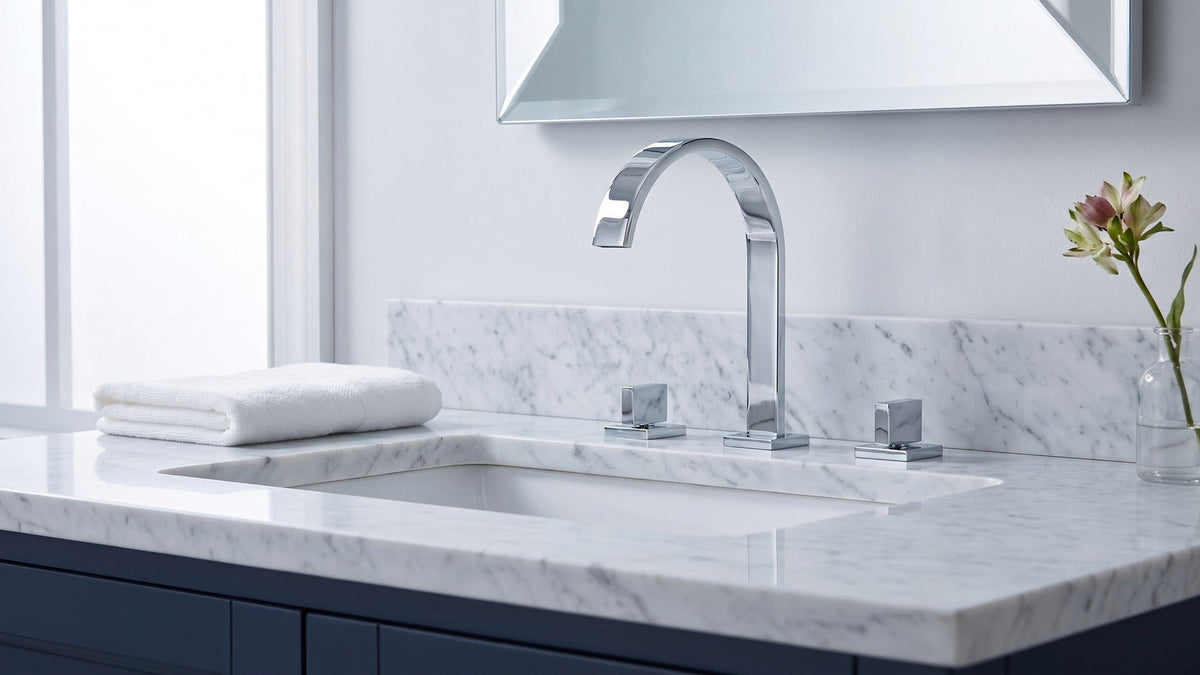
- Widespread: three separate pieces, spout and handles mount independently, spaced eight inches or more apart.
- A deck plate can cover extra holes so a single-hole or centerset faucet still fits a sink drilled for three.
- Widespread costs more and installs slower, but it is easier to clean around and offers more design variety.
How to check what your vanity already needs
- Count the holesLook under the sink or across the back of the countertop. One hole means a single-hole faucet. Three holes means centerset or widespread, and the spacing between the two outer holes tells you which.
- Measure center to centerMeasure from the center of one outer hole to the center of the other. About four inches apart is a centerset spread. Eight inches or more, and the holes are cut for a widespread faucet.
- Match the configurationA four inch spread needs a centerset or a deck plate paired with a single-hole faucet. Eight inches or more needs a genuine widespread, with its spout and two handles mounted separately.
Single-hole, centerset, and widespread: three configurations, not two
Shoppers often use centerset and single-hole as if they mean the same thing, and they do not. A single-hole faucet mounts through exactly one opening, with the handle built into the spout body itself. A centerset faucet also reads as one compact unit, but it actually covers three holes spaced about four inches apart, with the handles flanking a shared base plate that hides the middle hole. Widespread is the only configuration where the spout and each handle are entirely separate pieces with their own opening. If your countertop has one hole, single-hole is your only faucet option without cutting a new one. If it has three holes close together, centerset is the traditional match, though a single-hole faucet paired with a deck plate works just as well and gives you a wider style selection to choose from.
Centerset vs. widespread: the real differences
| Centerset | Widespread | |
|---|---|---|
| Pieces | One, spout and handles combined | Three, spout and each handle mount separately |
| Hole spacing | About 4 inches | 8 inches or more |
| Installation | Faster, fewer connections | Slower, three separate connections |
| Cleaning | Handles sit close to the spout | Wide gaps are easier to wipe down |
| Look | Compact, understated | Architectural, more finish and handle variety |
New build or replacement changes the math
If you are choosing a vanity and a faucet together, spread is mostly a design decision. A single large vessel basin usually reads better with a widespread faucet's spread out, architectural line, since there is enough counter for the spout and handles to sit apart without feeling cramped. A compact pedestal sink or a small guest bath basin usually suits the tighter single-hole or centerset footprint better, both visually and in terms of usable counter space. If you are replacing a faucet on an existing sink, the decision is already made for you. Buy to the holes you have, or budget for a plumber to cut new ones, which is rarely worth the cost for a faucet swap alone.
What actually costs more, and why
A centerset faucet is one casting with one set of internal waterways, assembled once at the factory. A widespread faucet is engineered as three independent parts that still have to seal correctly against each other's plumbing once installed, which means more machining, more finished surface, and a design that has to work from three separate mounting points instead of one. That is the real source of the price gap, not marketing. Installation labor follows the same logic: a plumber connecting three separate pieces underneath the sink bills more time than one connecting a single pre-assembled unit, so budget for both a higher sticker price and a longer install when you choose widespread.
What plumbers tend to point out
Ask a plumber which configuration they prefer and most will not pick a side on looks. What they will point out is that widespread parts are individually serviceable: a handle or a spout can be replaced on its own if it wears out, instead of pulling the entire faucet the way a one-piece centerset usually requires. A centerset's simplicity cuts both ways here. Fewer connections means fewer places to leak, but a full swap if any one part eventually fails.
Why widespread is worth the extra holes
None of this makes widespread the better choice outright. It makes it the choice with a different set of trade-offs, and worth the extra holes for the right bathroom.
The widespread trade-off
What works
- More finish and handle styles to choose from
- The wider gap between spout and handles makes daily cleaning easier
- Individual parts are replaceable instead of swapping the whole faucet
- Reads as the more architectural, higher end choice on a vanity
What to watch
- Needs three holes cut and correctly spaced before you buy
- Takes longer to install, with three separate connections under the sink
- Needs more clearance below the sink for the plumbing
- Costs more than a comparable centerset or single-hole model
What fits the widespread cut
Our Freyer widespread faucet is built for that eight inch and up spread: a squared spout and two independent handles, deck mounted across three holes, with a soft waterfall pour that suits a primary bath or a double vanity with room to spare.
Freyer, widespread
- Configuration
- 3-hole deck mount
- Handles
- 2, independent
- Spout
- Waterfall
- Style
- Modern, minimalist

If a single hole is all you have
If your vanity has just one hole, or you would rather keep the install simple, our Harris single-hole faucet is deck mounted with a single handle and the same modern lines, and it is a natural fit for a guest bath or a powder room where counter space is tighter. Browse the full Single Hole Bathroom Faucets collection, and for a deeper look at that configuration specifically, our single hole buying guide covers it in full.

Frequently Asked Questions
Can I put a widespread faucet on a sink with only one hole?
Not without drilling new holes. A true widespread faucet needs three separate mounting points spaced at least eight inches apart, so it only fits a sink or countertop already cut that way.
Are all widespread faucets exactly eight inches apart?
Eight inches is the standard, but the spout and handles mount independently, so many widespread faucets flex a little wider, often up to twelve to sixteen inches, using flexible supply lines.
Is a widespread faucet harder to install than a centerset?
Usually, yes. A centerset arrives as one pre-assembled unit with fewer connections. A widespread has three separate pieces that each need to be positioned, connected, and sealed correctly, which takes longer and more care underneath the sink.
Which is easier to keep clean, centerset or widespread?
Widespread, in most cases. The gap between the spout and each handle gives you room to wipe down the counter and the base of each piece. A centerset's parts sit close together, so grime collects in the tight seam faster.
Can a centerset sink be converted to widespread later?
Only by cutting new holes in the countertop, which most homeowners handle during a full vanity replacement rather than as a standalone project. A deck plate can go the other direction, letting a single-hole or centerset faucet sit on a sink already cut for widespread.
Do plumbers recommend one configuration over the other?
Most plumbers will not pick a side on looks, but they do point out that widespread faucets let you replace one worn part, like a handle, without swapping the whole unit, while a centerset's simpler one-piece build means fewer connections but a full replacement if it fails.